

.png)
Retailers around the world are facing the same challenge: how to increase product availability without sacrificing valuable selling space.
As store footprints become more expensive and labour costs continue to rise, businesses need solutions that improve operational efficiency while maintaining an attractive shopping environment.
This is why Integrated Rack Systems are becoming increasingly popular, especially across Latin America, where retailers often need to maximise inventory availability inside the store itself while operating within limited commercial space.
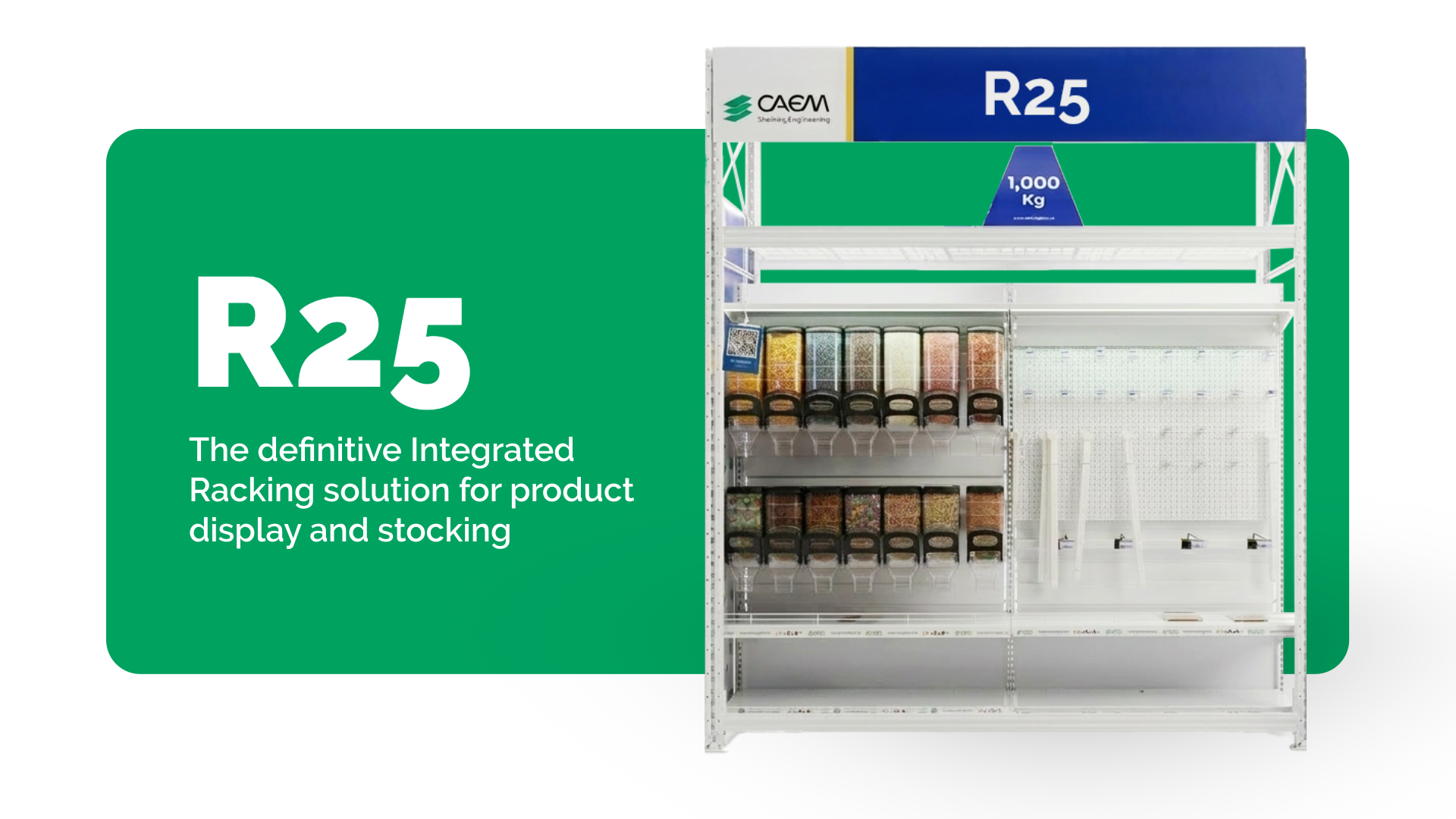
The CAEM R25 Integrated Rack System was developed precisely to address these challenges.
What is an Integrated Rack System?
An Integrated Rack System combines two essential retail functions within a single structure:
a retail display area in the lower section,
a high-capacity storage area in the upper section.
Instead of separating product display and inventory storage into different locations, retailers can manage both functions within the same square metre.
The result is a smarter use of space, faster replenishment and improved operational efficiency.
.png?width=3840&height=2160&name=R25%20gondola%20(2).png)
Display below, inventory above
The lower section of the R25 system is designed for merchandising.
Retailers can configure the gondola with:
shelves,
hooks,
accessories,
category-specific layouts.
Products remain easily accessible to customers while maintaining a high-quality presentation.
The upper section is intentionally left completely open and unobstructed to maximise stock storage capacity.
This elevated storage area becomes an integrated inventory reserve positioned directly above the products being sold.
Why use an integrated rack system?
The primary objective of an integrated rack system is to maximize the productivity of every square meter of the store. In many retail environments, selling space and storage space compete with each other. This is particularly true for supermarkets, minimarkets, wholesalers, convenience stores and fast-growing retail networks, where maintaining inventory close to the point of sale is essential. An integrated rack solves this challenge by allowing both functions to coexist within the same structure.
.png?width=3840&height=2160&name=R25%20wall%20(2).png)
The benefits of an integrated racking solution
Increased storage capacity
One of the most significant advantages of an integrated rack system is the ability to increase inventory capacity without increasing the store footprint.
The upper section of the structure can be used to store:
reserve stock,
cartons,
promotional inventory,
seasonal merchandise.
This enables retailers to significantly increase storage volume without expanding backroom facilities or investing in additional warehouse space.
Faster replenishment
Reserve stock is positioned directly above the products being sold.
Store employees can replenish shelves quickly because inventory is available within the same aisle.
This generates several operational benefits:
lower labour costs,
faster shelf replenishment,
reduced out-of-stock situations,
improved product availability.
By reducing the distance between stock and display, retailers improve both efficiency and service levels.
Better use of vertical space
Many retail stores have ceiling heights ranging from three to six metres.
However, most merchandising systems only utilize the lower two metres of available space.
An integrated rack transforms unused vertical volume into productive storage capacity.
Instead of leaving overhead space unused, retailers can generate additional value from the same store footprint.
Reduced backroom requirements
For many smaller stores and emerging retail formats, warehouse space is limited or completely unavailable.
This is particularly common in:
convenience stores,
neighbourhood supermarkets,
urban retail environments,
many Latin American retail formats.
An integrated rack allows a portion of inventory to be stored directly above the sales area, reducing dependence on dedicated stockrooms.
Available as Gondola and Wall Unit configurations
One of the strengths of the R25 system is its versatility.
CAEM supplies R25 in two different configurations:
R25 Gondola
Designed for central aisles where products are displayed on both sides of the structure. This solution maximises product exposure while maintaining integrated stock above.
R25 Wall Unit
Designed for perimeter walls and linear shelving runs. Retailers benefit from the same integrated inventory concept while optimising wall space.
This flexibility allows retailers to create a complete integrated rack layout throughout the store.
Technical dimensions of the R25 Wall Unit
The Wall Unit version provides the same operational advantages while optimising perimeter space.
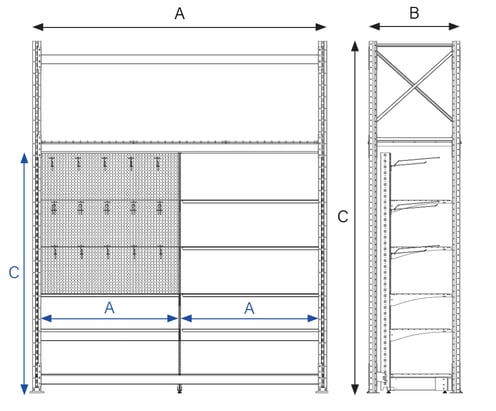
| width (A) | depth (B) | heights (C) | |
| Rack | 250 | 110 | 250 |
| 250 | 120 | 300 | |
| 250 | 130 | 350 | |
| a | b | c | |
| Gondola | 122 | 45 | 183 |
| 122 | 50 | 203 | |
| 122 | 60 | 223 |
| width (A) | depth (B) | heights (C) | |
| Rack | 198 | 110 | 250 |
| 198 | 120 | 300 | |
| 198 | 130 | 350 | |
| width (a) | depth (b) | heights (c) | |
| Gondola | 92 | 45 | 183 |
| 92 | 50 | 203 | |
| 92 | 60 | 223 |
Technical dimensions of the R25 Gondola
The R25 Gondola configuration combines a central merchandising area with elevated inventory storage.
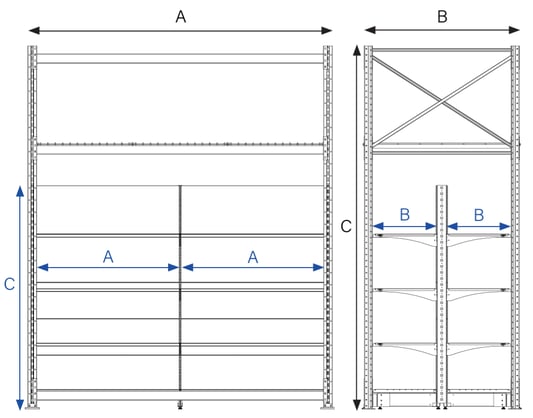
| width (A) | depth (B) | heights (C) | |
| Rack | 250 | 110 | 250 |
| 250 | 120 | 300 | |
| 250 | 130 | 350 | |
| width (a) | depth (b) | heights (c) | |
| Gondola | 122 | 45 | 183 |
| 122 | 50 | 203 | |
| 122 | 60 | 223 |
| width (A) | depth (B) | heights (C) | |
| Rack | 198 | 110 | 250 |
| 198 | 120 | 300 | |
| 198 | 130 | 350 | |
| width (a) | depth (b) | heights (c) | |
| Gondola | 92 | 45 | 183 |
| 92 | 50 | 203 | |
| 92 | 60 | 223 |
Why is the integrated rack concept particularly popular in Latin America?
and some ideal applications for R25
Integrated rack systems have become increasingly popular throughout Latin America because many retailers operate with:
smaller store footprints,
higher inventory levels,
limited warehouse space,
frequent manual replenishment processes,
rapidly expanding supermarket and convenience store networks.
For these reasons, integrated rack systems represent one of the most efficient methods for combining merchandising and inventory storage within the same store.
The solution allows retailers to maximize product availability while maintaining controlled investment costs.
The system is particularly suited for:
supermarkets,
grocery stores,
discount retailers,
DIY stores,
hardware stores,
garden centres,
automotive parts retailers,
technical retail environments.
Any business that needs to combine display quality with efficient inventory management can benefit from an integrated rack solution.
When should you choose an integrated rack system?
An integrated rack is the ideal solution when:
the store has limited backroom space,
replenishment frequency is high,
inventory must remain close to the point of sale,
available ceiling height is underutilized,
additional storage capacity is required without reducing selling space,
a growing retail network requires a scalable and cost-effective layout solution.
In these situations, the integrated rack provides immediate operational advantages.
The business impact
From a commercial perspective, an integrated rack system helps retailers:
increase product availability,
reduce replenishment time,
improve operational efficiency,
increase storage capacity,
optimize floor space utilization,
reduce stockroom requirements,
support future store growth without increasing footprint.
In simple terms, an integrated rack transforms unused vertical space into a strategic asset, allowing the store to function simultaneously as a sales area and a storage area.
FAQ
What is an Integrated Rack System?
An Integrated Rack System combines retail display and inventory storage within a single structure. Products are displayed in the lower section while reserve stock is stored directly above.
Why are integrated rack systems popular in Latin America?
Many Latin American retailers operate with limited backroom space and high inventory turnover. Integrated rack systems maximise product availability while reducing replenishment time.
What is the main advantage of the R25 system?
R25 allows retailers to use the same space for both merchandising and inventory storage, improving efficiency and increasing productivity per square metre.
Is R25 available only as a gondola?
No. CAEM offers R25 both as a Gondola configuration for central aisles and as a Wall Unit configuration for perimeter shelving.
Which retail sectors benefit most from R25?
Supermarkets, grocery stores, discount retailers, DIY stores, hardware stores, garden centres, automotive retailers and technical retail businesses can all benefit from the system.
.png)